Debt Snowball vs Avalanche: Which Order Fits Your Debts? (3 Lists Run Both Ways)
Debt snowball vs avalanche on 3 example debt lists: the avalanche saved $1,359 on one, $290 on another and $0 on the third. Here's how to tell which you have.
By Debt Payoff Planner by Cosmo Suite · Editorial policy
Published · 10 min read
The debt avalanche never costs more interest than the debt snowball. How much less it costs is the part worth knowing, and on many debt lists the answer is "not much". The snowball pays the smallest balance first and the avalanche pays the highest APR first, with the same debts and the same monthly total.
We ran three example debt lists both ways, month by month. The avalanche saved $1,359 on the first, $290 on the second and nothing at all on the third, and the final payoff dates landed within one month of each other every time.
So the useful answer is a test you can run on your own list. Doing it by hand means sorting everything twice and redoing it after every payoff, which is why a spreadsheet that runs the snowball and avalanche side by side saves real effort here.
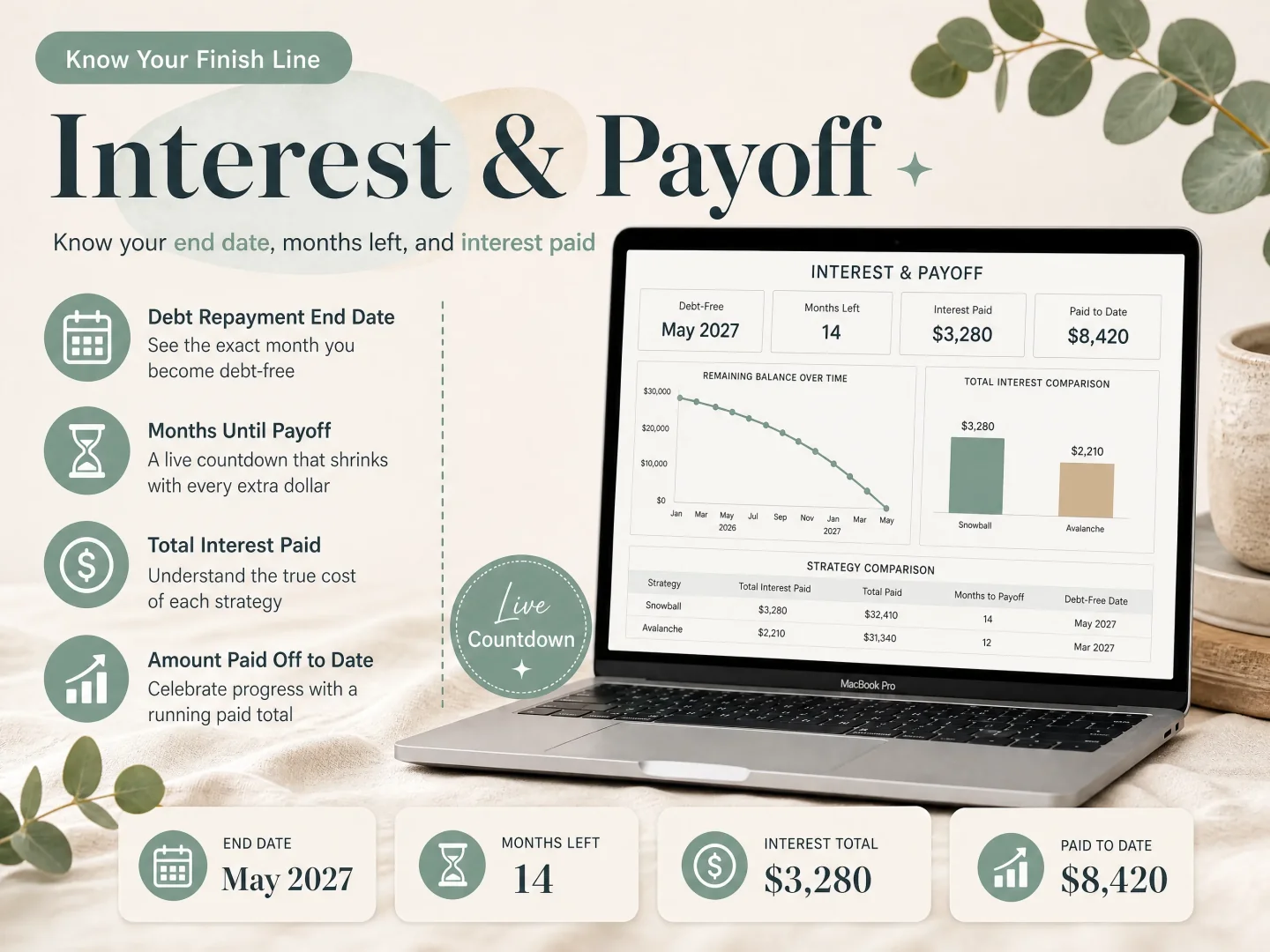
Your date, from the first example below:
- Payoff order: avalanche clears the 27.9% credit card first; snowball clears the $900 medical bill first.
- Debt-free month: October 2028 with the avalanche, November 2028 with the snowball (November 2026 start).
- The change that moves the date most: $100 more a month, which beats switching methods by 2 months.
Snowball vs Avalanche at a Glance
The debt snowball is a payoff order that sends every extra dollar to your smallest balance first, while paying minimums on everything else. The debt avalanche is the same plan sorted by interest rate instead, highest APR first.
| Debt snowball | Debt avalanche | |
|---|---|---|
| Sorts by | Balance, smallest first | APR, highest first |
| First paid-off debt | Early, often in the first few months | Later, unless the top-rate debt is small |
| Total interest | Equal or higher | Equal or lower |
| Where it slips | A big high-rate debt waits until last | A long wait before the first win |
| Best for | Lists with similar rates, or when you need proof it's working | Lists with one large, expensive debt |
Fidelity's guide to both methods puts the trade-off plainly: you save more interest with the avalanche, but when your rates are similar or low, it "may not be much more efficient than the snowball approach." The three lists below put a number on "much".
Running Both Orders on Three Debt Lists
On our three lists, the avalanche saved $1,359, $290 and $0, and it never finished more than one month sooner. These are example numbers, not typical ones.
Methodology: we calculated each list month by month from November 2026. Interest is charged monthly at APR ÷ 12, minimums stay fixed, and every freed minimum rolls into the next debt. The monthly total never changes. Each list's extra payment goes to the top debt in that method's order.
List 1: One Big, Expensive Card
Four debts with a wide rate gap. The $9,800 card at 27.9% is both the largest balance and the most expensive.
| Debt | Balance | APR | Minimum |
|---|---|---|---|
| Medical payment plan | $900 | 0% | $75 |
| Credit union loan | $2,200 | 8.5% | $90 |
| Car loan | $6,500 | 6.9% | $210 |
| Credit card | $9,800 | 27.9% | $300 |
Minimums total $675 (sample data, November 2026 start), plus $300 extra, so $975 a month.
| Debt | Snowball paid off | Avalanche paid off |
|---|---|---|
| Medical payment plan | Month 3 (Jan 2027) | Month 12 (Oct 2027), on its minimum |
| Credit union loan | Month 7 (May 2027) | Month 21 (Jul 2028) |
| Car loan | Month 15 (Jan 2028) | Month 24 (Oct 2028) |
| Credit card | Month 25 (Nov 2028) | Month 20 (Jun 2028) |
| Total interest | $4,769 | $3,410 |
The avalanche saves $1,359 and finishes one month sooner, while the snowball gets its first win nine months earlier.
List 2: Student Loans With Close Rates
Four loans with rates between 5.5% and 9.9% (sample data, November 2026 start). Minimums total $430, plus $200 extra, so $630 a month.
| Debt | Balance | APR | Minimum | Snowball paid off | Avalanche paid off |
|---|---|---|---|---|---|
| Personal loan | $3,100 | 9.9% | $105 | Month 11 (Sep 2027) | Month 11 (Sep 2027) |
| Federal student loan A | $4,200 | 5.5% | $95 | Month 20 (Jun 2028) | Month 49 (Nov 2030) |
| Federal student loan B | $7,800 | 6.5% | $90 | Month 34 (Aug 2029) | Month 49 (Nov 2030) |
| Private student loan | $11,500 | 8.2% | $140 | Month 50 (Dec 2030) | Month 38 (Dec 2029) |
| Total interest | $4,401 | $4,111 |
The gap shrinks to $290 over four years, about $6 a month. Both methods start with the same loan, because the smallest one also has the top rate. After that, the snowball closes a second loan in month 20, while the avalanche makes you wait until month 38.
List 3: The Smallest Debt Has the Highest Rate
Three debts, $410 in minimums plus $150 extra ($560 a month).
| Debt | Balance | APR | Minimum | Both methods paid off |
|---|---|---|---|---|
| Store card | $450 | 26.99% | $30 | Month 3 (Jan 2027) |
| Credit card | $3,200 | 22% | $95 | Month 16 (Feb 2028) |
| Car loan | $12,000 | 6.4% | $285 | Month 32 (Jun 2029) |
Sorted by balance or by rate, this list comes out in the same order, so both plans pay $1,811 in interest and finish in June 2029.
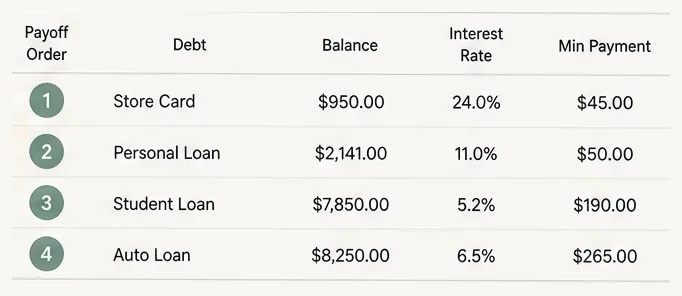
The spreadsheet's own sample list below splits near the end instead. Sorted for the snowball, the $7,850 student loan at 5.2% comes before the $8,250 auto loan at 6.5%; an avalanche would swap those two and keep the rest.
When Is the Gap Big Enough to Matter?
The gap gets big when the snowball leaves a large, high-rate balance waiting near the end. To spot it, look at each debt's balance and rate together.
On List 1, the $9,800 card charges about $228 of interest in its first month ($9,800 × 27.9% ÷ 12). Under the snowball it receives only its minimum for 14 months while three cheaper debts go first, and that waiting time produces most of the $1,359 difference.
For context, card accounts that were charged interest averaged a 22.15% rate in the second quarter of 2026, according to the Federal Reserve's G.19 consumer credit release. At that average rate, the same $9,800 would cost about $181 a month while it waited.
Run this 30-second test on your own list:
- Sort your list by balance, then sort it again by APR.
- If the same debt is at the top of both, the methods start the same way. Check the second debt the same way.
- If the orders split, find the debt the snowball pushes furthest back. Multiply its balance by its APR and divide by 12: that's roughly what each month of waiting costs. For example, a $5,000 card at a 24 percent APR costs about $100 a month.
If the answer is a few dollars a month, the choice is mostly about motivation. If it's a few hundred, the avalanche is buying you real money.
What the Research Says About Small Wins
The research backs both methods, which is why people keep arguing about it.
Small wins predict finishing. David Gal and Blakeley McShane, researchers at Northwestern's Kellogg School, studied nearly 6,000 clients of a debt settlement company. Kellogg Insight reports that the number of accounts closed "better predicted successfully completing the program than the dollar amount."
Small wins can cost money. Debt account aversion is the name researchers gave to the pull toward closing small accounts, even when bigger ones cost more. Moty Amar, Dan Ariely and colleagues described it in the Journal of Marketing Research. In four experiments, "participants consistently pay off small debts first, even though the larger debts have higher interest rates." Directing participants' attention to the interest each debt had accumulated helped them reduce their overall debt more quickly.
Fewer bills can be a cushion. A point that comes up often in debt forums: the snowball cuts the number of required payments sooner. On List 1, after month 18 the snowball leaves one minimum due ($300). The avalanche still leaves three ($600). If your income dropped that month, the smaller required total would matter more than the interest.
Read together, the studies say the urge to close small accounts is real and useful, and it also has a price. On our three lists that price ran from $1,359 down to nothing, depending on the debts.
How to Choose in 4 Steps
Choose by pricing the gap on your own list, then picking the order you'll keep paying.
Step 1: List Every Debt
Write down each balance, APR and minimum from your latest statements. Include small debts such as medical bills and store cards, since they change the snowball order most.
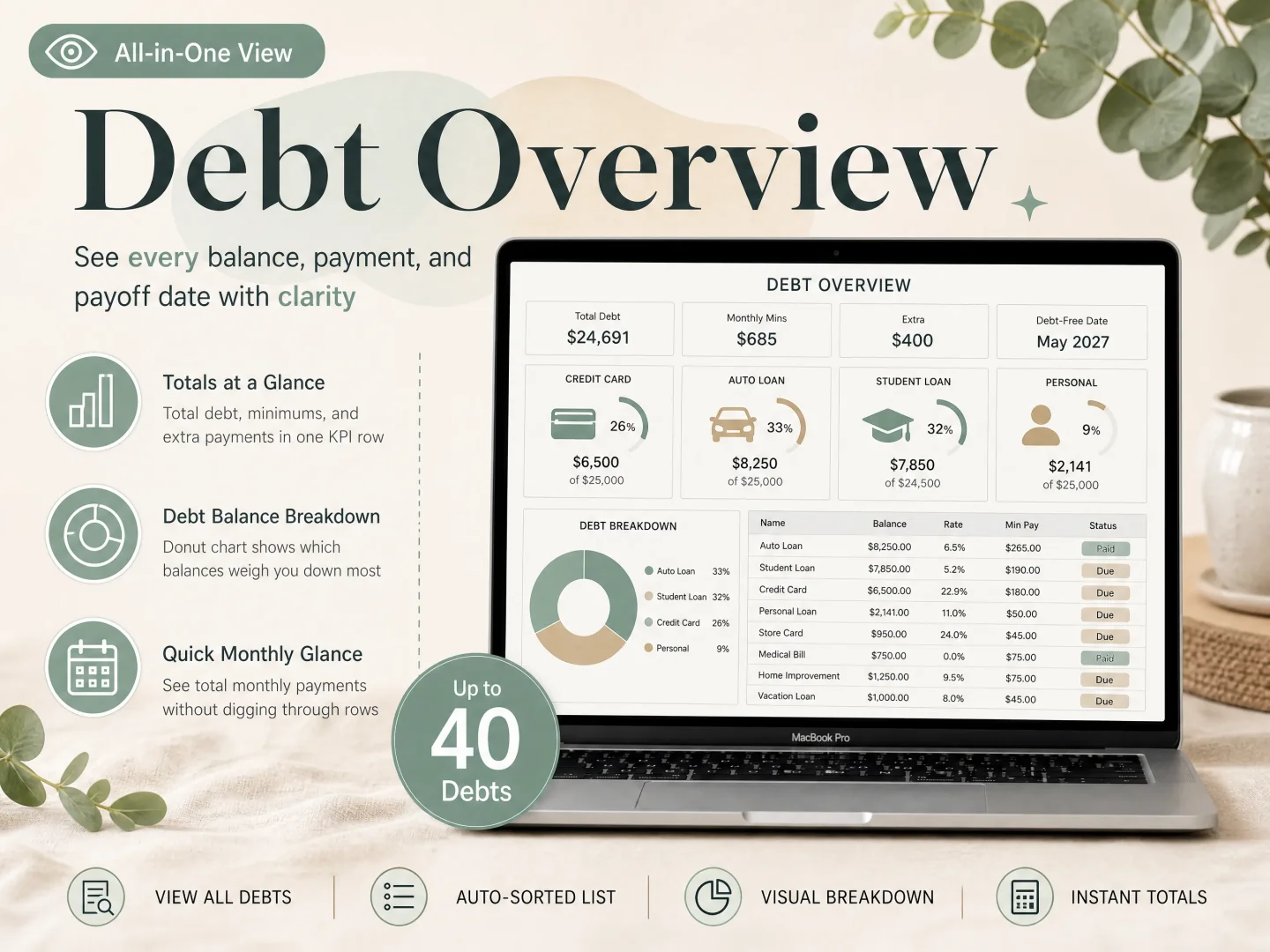
In the sheet: the debt list on the overview tab, one row per debt, up to 40.
Step 2: Sort It Both Ways
Put the list in balance order and in APR order next to each other, then run the 30-second test from the section above.
In the sheet: the snowball and avalanche tabs sort themselves from the same list.
Step 3: Price the Gap
Compare total interest and the debt-free month for each order, and note the month of your first paid-off debt under each.
In the sheet: the interest and payoff view shows both totals and both dates.
Step 4: Pick the One You'll Keep Paying
If the gap is small, take the snowball's early wins without guilt. If it's large and you trust yourself to wait, take the avalanche; either one beats a plan you abandon by spring.
In the sheet: the payment schedule for the order you choose, month by month.
Is There a Middle Ground?
Yes. A common hybrid clears one small debt first for a quick win, then switches to the highest interest rate for everything that remains. On List 1, that means paying off the $900 medical plan, then the card, the credit union loan and the car loan.
| Order on List 1 | First paid-off debt | Debt-free | Total interest |
|---|---|---|---|
| Snowball | Month 3 | Month 25 (Nov 2028) | $4,769 |
| Hybrid: smallest first, then highest APR | Month 3 | Month 24 (Oct 2028) | $3,551 |
| Avalanche | Month 12 | Month 24 (Oct 2028) | $3,410 |
The hybrid keeps the month-3 win and gives up $141 compared with the pure avalanche, which is an inexpensive trade on this particular list.
Another reason for a custom order is a promotional rate with an expiration date. A zero-interest balance sorts last in an avalanche, but if the rate jumps on a known date, you may want it paid off before then.
What Moves Your Debt-Free Date More Than the Method
The size of your extra payment moves the date far more than the order you pick. Here is List 1 at four extra amounts, run both ways.
| Extra per month | Snowball | Avalanche |
|---|---|---|
| $200 | 29 months, $5,436 interest | 27 months, $4,123 interest |
| $300 | 25 months, $4,769 interest | 24 months, $3,410 interest |
| $400 | 22 months, $4,246 interest | 21 months, $2,917 interest |
| $500 | 20 months, $3,830 interest | 19 months, $2,554 interest |
Switching methods at $300 extra moves the date by one month. Adding $100 to the snowball moves it by three, and it finishes two months ahead of the $300 avalanche, though it pays more interest along the way.
Pick the extra first, then the order. Settle on an amount you can repeat even in an expensive month, because that number decides most of your date.
Keep the freed payment working. The rollover is the step where a paid-off debt's minimum joins the payment on the next debt in line. A payment schedule that applies the rollover for you keeps that money from drifting back into spending.
Re-run it when something changes. A raise, a new charge or a rate change can flip the order, so recalculate before assuming last month's plan still holds.
Get help if the minimums don't fit. The FTC's page on how to get out of debt suggests a credit counseling program and warns that nonprofit status alone doesn't make a service free or legitimate.
How We Put This Together
We're the Cosmo Suite team that built Debt Payoff Planner; read about us and how to contact us. The three lists were calculated month by month on 4 October 2026 with the assumptions stated, and sources were checked the same day under our editorial policy. This is general information, not financial advice. For your situation, a nonprofit credit counselor (an NFCC member) can help.
Where Debt Payoff Planner Fits
Choosing between snowball and avalanche is quick once both orders are in front of you on your own numbers. Getting them there, and keeping them accurate after every payoff, is the slow and error-prone part.
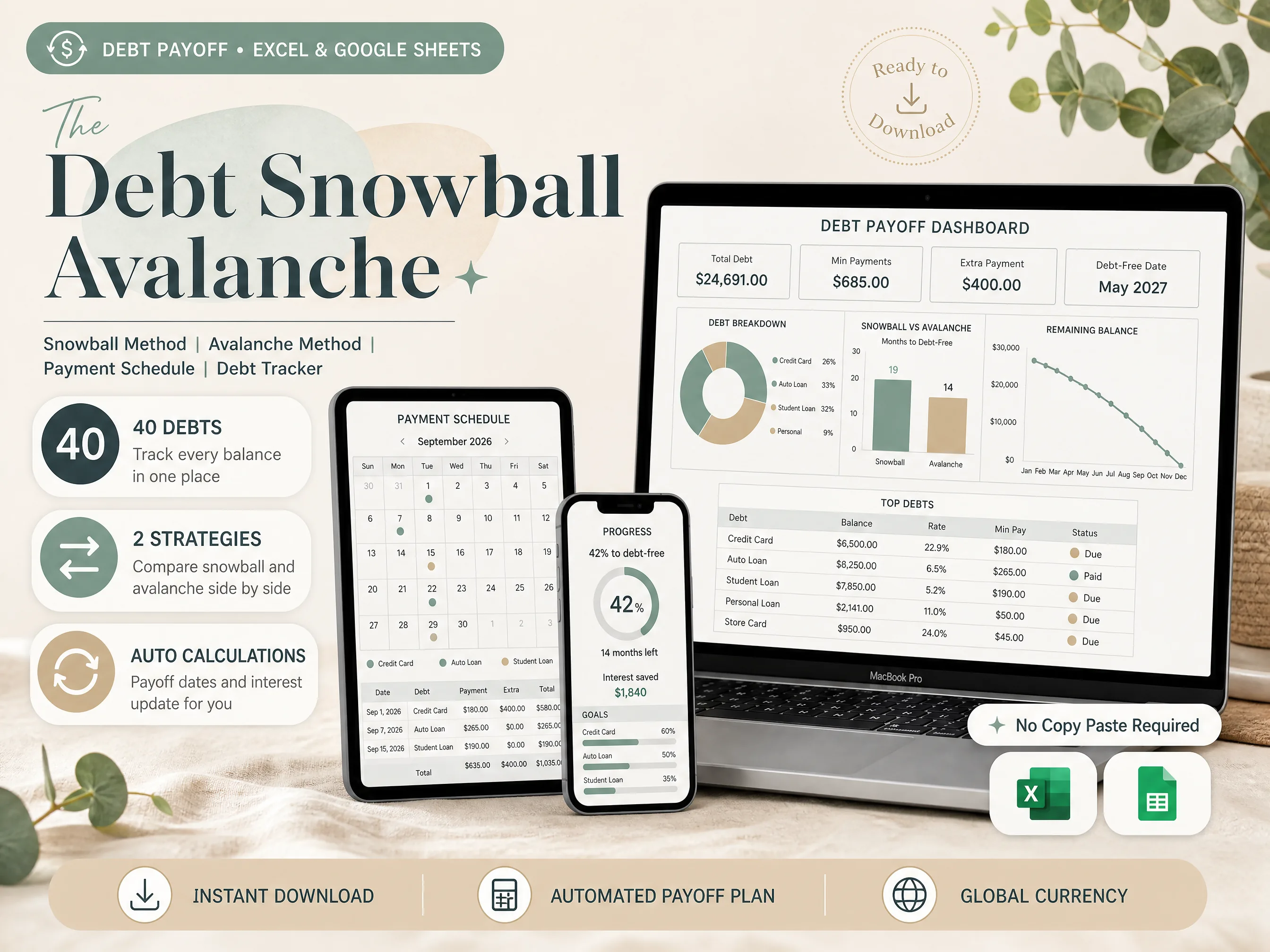
Debt Payoff Planner, the snowball and avalanche spreadsheet for Excel and Google Sheets, holds up to 40 debts in one file and runs both methods side by side from the same list. It builds an auto-sorted payment schedule, and the interest and debt-free date update as your balances fall.
That means you can run the 30-second test without sorting anything by hand, then follow the order you picked month by month. Both an Excel file and a Google Sheets copy are included.
If you're still choosing a format, start with what a debt payoff spreadsheet needs and how it picks your order. If you've already settled on the snowball, see how to set up a debt snowball spreadsheet step by step. Or preview every tab of the snowball and avalanche spreadsheet before you buy.
Frequently asked questions
Which saves more money, the debt snowball or the debt avalanche?
The avalanche, or the two tie. Paying the highest APR first never costs more interest than paying the smallest balance first. How much it saves depends on your list. In our three examples the gap was $1,359, $290 and $0, so run your own numbers before deciding the choice is a big one.
Is the debt snowball faster than the debt avalanche?
Not for the final date on our three lists, where the two methods finished within one month of each other. That holds for these lists only: Fidelity's own example has the avalanche finishing in about 9 years and the snowball in about 10. Where the orders differ, the snowball reaches a first paid-off debt sooner: on our List 1 that came in month 3, against month 20 for the avalanche's first targeted debt.
What if my smallest debt also has the highest interest rate?
Then the snowball and the avalanche start in the same place, and they may be identical. In our third example the smallest debt was a 26.99% store card (sample data, November 2026 start), the orders matched debt for debt, and both plans paid $1,811 in interest. Check the second debt on each list too, since that's where orders often split.
Where should a zero-interest balance go in the payoff order?
The avalanche puts a zero-interest balance last, because it costs nothing while you wait. The snowball puts it wherever its balance sorts, which is often first. If a promotional rate ends on a set date, note that date, because the balance will start charging interest and may need to move up.
Sources
- Fidelity Viewpoints: Debt snowball method vs. debt avalanche method (January 21, 2026)
- Kellogg Insight: To Beat Debt, Consider Starting Small (Gal and McShane, January 8, 2014)
- Amar, Ariely, Ayal, Cryder and Rick: Winning the Battle but Losing the War: The Psychology of Debt Management (Journal of Marketing Research, 2011)
- Federal Reserve Board: G.19 Consumer Credit, release of September 8, 2026
- Federal Trade Commission: How To Get Out of Debt