Does Debt Go Away After 7 Years? The Three Clocks
Seven years usually refers to credit reporting, not debt cancellation. Learn how credit-report, lawsuit, and collection timelines differ.
By Debt Payoff Planner by Cosmo Suite · Editorial policy
Published · 7 min read
General information, not financial advice.
Not legal advice; for your case, talk to a licensed attorney or a nonprofit legal aid group.
Does debt go away after 7 years? Usually, that figure refers to how long most negative information may stay on a credit report. It does not erase what you owe. People often mix this reporting period with the lawsuit deadline and the time a collector may keep trying to collect.
The timelines use different rules and can start from different events. Credit reporting is the process of listing account information in a consumer report. The Consumer Financial Protection Bureau (CFPB) says most negative information can generally be reported for seven years. The CFPB and Federal Trade Commission (FTC) explain that old debts and lawsuits have separate rules that can depend on the type of debt and the law that applies.
The Three Debt Timelines at a Glance
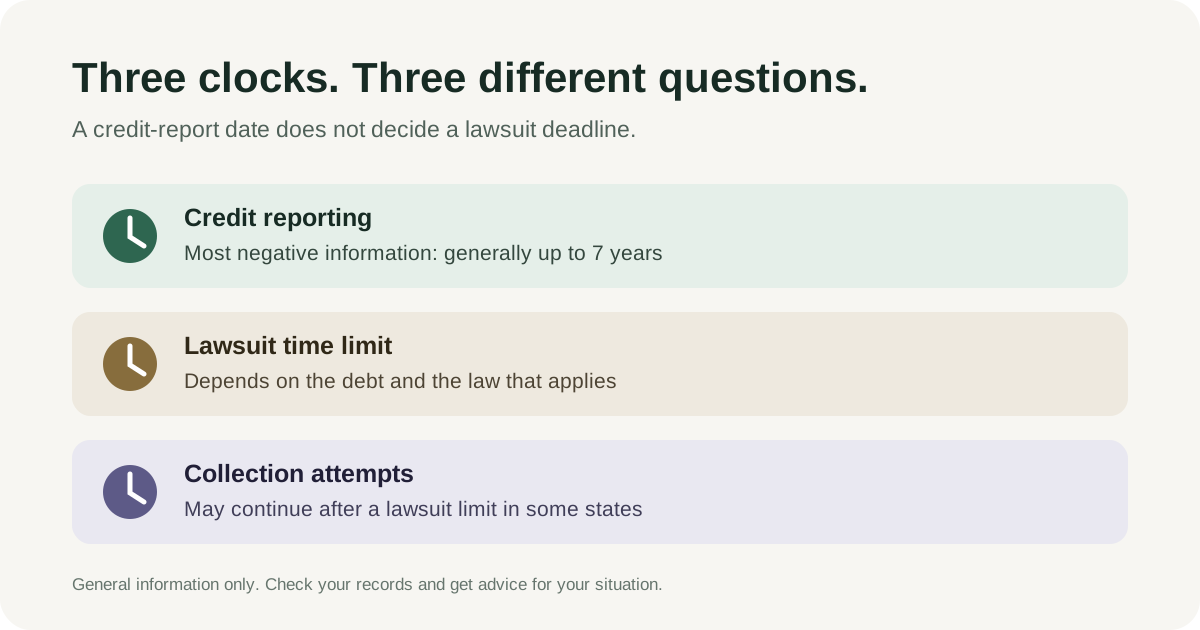
The credit-reporting clock, lawsuit clock, and collection clock answer different questions. A date on one clock does not settle the other two.
| Timeline | What it answers | What the general rule says | What can change it |
|---|---|---|---|
| Credit reporting | How long can negative account information appear on a report? | Most negative information can generally be reported for up to seven years. | The type of information and its legally relevant date; judgments and bankruptcies have different reporting rules. |
| Lawsuit time limit | Can a creditor or collector use a lawsuit to collect? | A time limit may apply, but there is no single seven-year period for all debts. | Debt type, applicable state law, contract terms, and account history. |
| Collection attempts | Can a collector still contact you or ask for payment? | Contact may continue after a lawsuit time limit has passed in many states. | State law and the facts of the account. Contact does not prove that a lawsuit is allowed. |
The CFPB notes that most states’ lawsuit time limits vary by debt type and may depend on the state where you live or a state named in the credit agreement. A partial payment or acknowledgment can affect that period in some states. Do not use the credit-reporting period as a shortcut for deciding whether a debt is legally enforceable.
What the Seven-Year Credit-Report Clock Measures
The seven-year rule is mainly about reporting negative account information. It does not mean the balance is forgiven after seven years, and it does not tell you whether a collector can still contact you or file a lawsuit.
The FTC explains that the reporting period for a delinquent debt is generally tied to the date of delinquency, not a later event such as when the account is sent to a collector or charged off. The CFPB’s credit-reporting guidance says most negative information can generally be reported for seven years. It also notes that judgments and bankruptcies have different reporting limits.
If an account appears on a report after you expect it to have been removed, check the dates and account details. A collection account can be sold or transferred, and the name on the entry may change. That alone does not establish that the reporting date is wrong. Compare the listed delinquency date with your records and use the credit bureau’s dispute process if you find an error.
Accurate negative information does not become inaccurate just because it is stressful or old. The CFPB says no one can remove accurate negative information simply by charging a credit-repair fee. You can challenge information that is wrong, incomplete, or not yours.
A Charge-Off Does Not Cancel the Balance
A charge-off is an accounting status that a creditor may use after it considers an account unlikely to be repaid. It does not by itself cancel the balance. The CFPB’s legal aid materials explain that a charge-off does not by itself stop the original creditor or a collector from attempting to collect.
The account may still appear on a credit report under the applicable reporting rules. A later sale or transfer does not create a new credit-reporting period. The history of the original account still matters, even if a different company contacts you.
That is why “charged off,” “sold,” “in collections,” and “removed from a credit report” are not interchangeable labels. Each describes a different part of the account’s history. A charge-off does not tell you whether the account is time-barred or whether a lawsuit can proceed.
The Lawsuit Clock Depends on the Debt and Applicable Law
A statute of limitations is the law’s time limit for bringing a lawsuit. There is no universal seven-year deadline for every consumer debt. The CFPB says the period can depend on the type of debt, the state where you live, and state law named in a credit agreement. Federal student loans can follow different rules.
The starting event can vary too. In some states, the period starts when a required payment is missed. In others, it can be based on the most recent payment. The CFPB also warns that a partial payment or an acknowledgment may restart the period in some states.
This is why an old debt deserves care before you respond. A collector’s letter does not show that a lawsuit deadline has passed, and the age shown on a credit report does not calculate that deadline for you. If a lawsuit has been filed, follow the response date on the court papers and seek legal help promptly. Do not ignore court papers because you believe a debt is old.
For a general overview of collection limits and old debts, see the CFPB’s explanation of collecting older debts. It explains why a person’s location, debt type, payment history, and contract can matter. It does not determine the deadline for an individual account.
Can Collectors Still Contact You About an Old Debt?
Sometimes. In many states, a collector can still try to collect after the time limit for suing has expired. Whether contact is allowed can depend on state law. A collector also cannot use an unlawful threat or misrepresent the debt’s legal status.
The FTC’s debt collection FAQ separates contact from a lawsuit. It says some states restrict contact about time-barred debt, while others allow collectors to continue seeking payment. The FTC also warns that, in some states, making a payment or acknowledging a debt in writing may restart the lawsuit clock.
If the collector is unfamiliar, first confirm who is contacting you and which account it concerns. You can ask for information that helps identify the original creditor and the amount claimed. The CFPB’s debt validation letter guide explains the validation process. If a collector threatens to sue, demands immediate payment, or gives a deadline, keep the notice and get advice about your situation.
What to Check Before You Respond
An old account can raise separate questions about accuracy, ownership, amount, and legal timing. Keep those questions separate as you review the records.
- Read the credit report entry. Note the account name, balance, status, and delinquency date. Check whether the same account appears more than once.
- Compare it with your own records. Look for old statements, payment confirmations, account letters, and any notice that the account was sold or transferred.
- Check who contacted you. Confirm the collector’s identity and the original account before sharing personal or payment information.
- Do not guess at a lawsuit deadline. The credit-reporting date and the time limit for a legal case are different. The applicable limit can turn on local law and account details.
- Get help if a legal deadline may be involved. A licensed attorney or nonprofit legal aid group can review the documents with you. A court summons needs a timely response, even if you believe the debt is too old.

If a report contains information you believe is inaccurate, the CFPB explains how to dispute a credit-report error. For other collection concerns, you can also read our guide to what happens when a collector may garnish wages.
How We Checked the Timelines
We checked the CFPB and FTC pages linked here on October 22, 2026. They describe general federal guidance and explain where state law or debt type can change the answer. This article does not calculate a lawsuit deadline or decide whether a particular balance is owed. The About page identifies who publishes this blog, the editorial policy explains how articles are checked, and you can contact us to flag a changed source or an error.
Seven years usually limits how long negative information may appear on a credit report. It does not automatically cancel a debt or answer whether a lawsuit can be filed or a collector may contact you. For one account, check the records and get legal help before relying on a general timeline.
Frequently asked questions
Does debt disappear after 7 years?
No. Seven years usually refers to how long most negative information may appear on a credit report. It does not by itself cancel the debt or settle a collector’s account. The time limit for a lawsuit is a separate question that depends on the debt and applicable law.
Can a debt collector sue after 7 years?
There is no single seven-year lawsuit rule for every debt. The time limit can depend on the type of debt and the law that applies. A partial payment or written acknowledgment may affect the time limit in some states, so get legal help before responding if the date matters to you.
Can a collector contact me about a debt older than 7 years?
Sometimes. In many states, collectors may still try to collect after the time limit to sue has passed, but state laws differ. A collector’s contact does not prove that a lawsuit is allowed or that the amount is correct.
Does a charge-off erase the debt?
No. A charge-off is a creditor’s accounting status. It does not automatically cancel the balance or remove the account from your credit report. The original creditor or a collector may still seek payment.
What should I check if an old debt appears on my credit report?
Check the account details and the date the delinquency began, then compare them with your records. If information is inaccurate, you can dispute the error with the credit reporting company and the company that supplied it. For questions about a lawsuit deadline, talk with a licensed attorney or nonprofit legal aid group.
Sources
- CFPB: How long does information stay on my credit report?
- CFPB: How do I dispute an error on my credit report?
- FTC: Consumer Reports: What Information Furnishers Need to Know
- CFPB: Can debt collectors collect a debt that’s several years old?
- FTC: Debt Collection FAQs
- CFPB: Your Money, Your Goals legal aid knowledge assessment
